Most people do not avoid strength training because they are lazy. They avoid it because it feels unfamiliar, intimidating, or unnecessary.
Many wait until later in life to start.
After the back pain.
After the first fall.
After the doctor says bone density is low.
After clothes stop fitting the same.
The good news is that progress can happen at any age. In fact, some of the fastest strength and confidence gains we see at the Transformation Center come from adults in their 60s and 70s starting for the first time.
But there is a truth worth hearing early.
Changing habits after decades is harder than building them sooner.
Old habits do die hard.
That is why understanding heavy strength training now matters. Not someday. Not after a scare. Now.
What Qualifies as “Heavy” Training
When people hear heavy weights, they often picture bodybuilders or powerlifters. That is not what we mean.
In research terms, heavy strength training generally refers to lifting a load that feels challenging within about 5 to 8 repetitions.
By the last rep, you should feel like you could maybe do one more if you had to.
That level of effort is what signals the body to adapt.
Lighter weights for endless repetitions can improve endurance.
Heavy enough weights improve strength, bone density, and muscle preservation.
A 2021 review in Sports Medicine and Frontiers in Physiology showed that resistance training in moderate to lower rep ranges produces significantly greater improvements in:
- Muscle mass retention
• Bone mineral density
• Functional strength
• Fall risk reduction in older adults
This is not about lifting maximal loads.
It is about using enough resistance to create a meaningful stimulus.
Why Building Muscle Is Easier Earlier and Why It Still Works Later
Men and women naturally have higher anabolic hormone levels in early adulthood. Testosterone, growth hormone, and IGF-1 (Insulin like Growth Factor 1 hormone) all support muscle building.
That means younger adults can build muscle faster.
But once muscle is built, it is far easier to maintain than to create from scratch, especially as we age.
Muscle fibers add myonuclei when trained. Those nuclei remain even if training pauses. That is one reason returning to training later is easier if you built strength earlier in life.
The other reason is behavioral.
Building muscle requires consistent nutrition, recovery, and training habits. Once those habits exist, maintaining them becomes part of identity rather than a chore.
This is why starting earlier pays compounding dividends.
But starting later still works beautifully.
Why Heavy Strength Training Matters for Every Stage of Life
For the busy mom struggling with body image:
Strength training improves body composition without chasing restrictive diets. More muscle means more shape, firmness, and metabolic flexibility.
For the 45+ adult who stays active but does not lift heavy:
Strength training protects joints, improves posture, and prevents the slow drift toward loss of mobility that often happens unnoticed.
For the 65+ feeling balance and confidence slip:
Resistance training improves bone density, reduces fall risk, and makes daily tasks easier. Carrying groceries, getting off the floor, climbing stairs. These are strength skills.
For everyone:
Muscle is a key organ of longevity. It improves insulin sensitivity, supports metabolic health, and protects independence.
If the goal is losing inches, building muscle is not optional.
It is the foundation.
Training Close to Failure: What That Really Means and Why It’s Vital
Training “to failure” simply means performing a set until you cannot complete another repetition with good form.
Training close to failure signals the nervous system and muscle fibers to adapt.
It recruits more muscle fibers, increases strength gains, and improves muscle retention during fat loss.
A triple win.
You do not need to hit failure on every set, nor should you, but regularly approaching it safely is what separates real strength progress from just moving weights around.
This is where coaching matters.
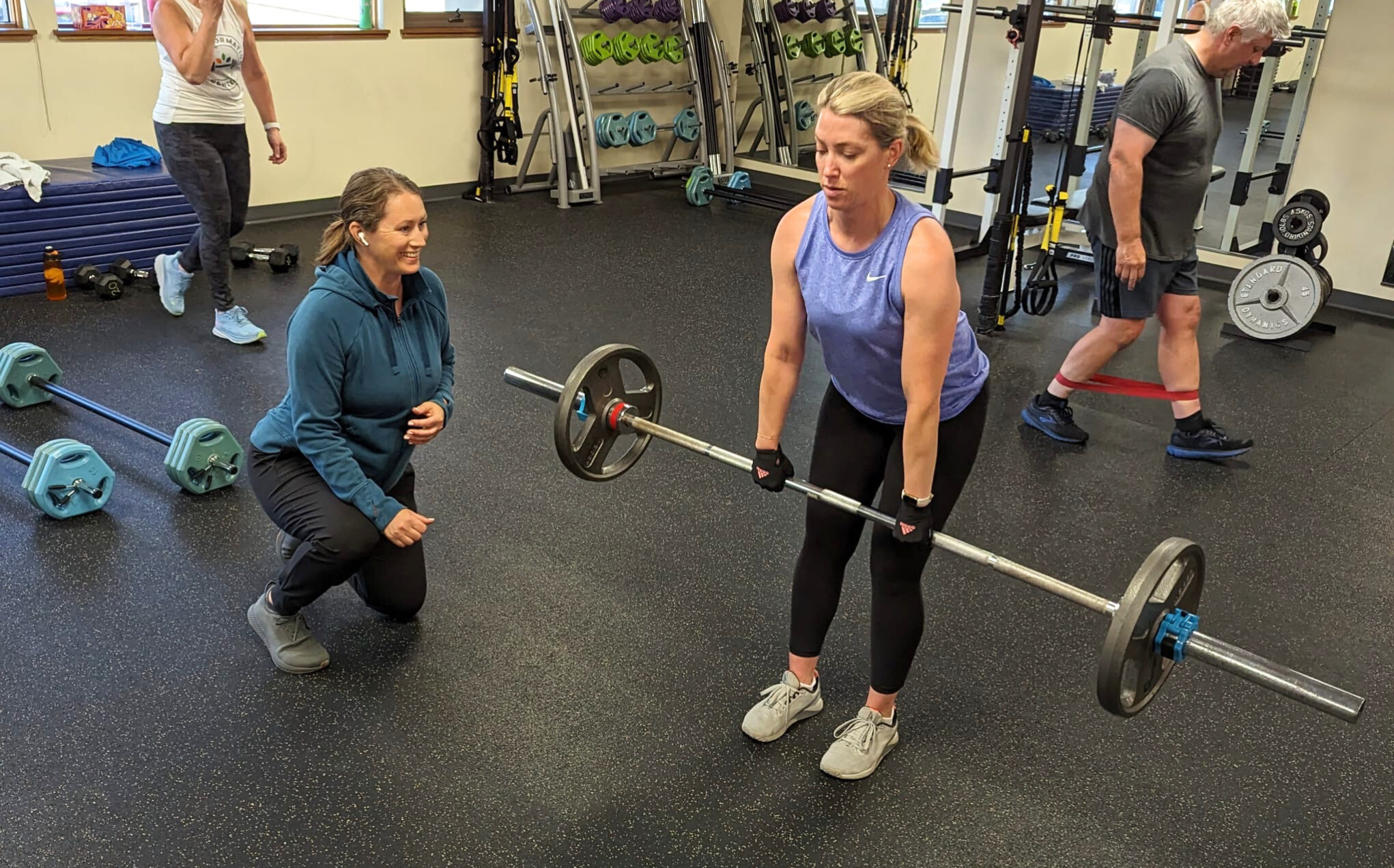
Form, technique, breathing, and load selection all influence results and injury risk.
How Often Should You Strength Train
For most adults, research supports:
- 2 to 3 full-body or split sessions per week
- Progressive load over time
- Rest periods of 1 to 3 minutes
- Consistent effort near challenging intensities
Goals change the details, but the principle stays the same.
Stimulate the muscle. Recover. Repeat.
Fueling Heavy Training
Muscle does not grow from workouts alone and without the following, your workouts may even start to drain you…
Recovery and nutrition.
Adequate protein provides building material.
Hydration supports performance and joint health.
Fiber and micronutrients support digestion, hormone balance, and energy levels.
Rest between sets allows strength output to stay high.
Under-fueling and under-recovering turn good training into frustration.
What You Can Do Starting This Week
Choose a program that prioritizes real strength training
- Start with manageable loads and progress gradually
- Seek coaching for form and confidence
- Eat enough protein and drink enough water
- Be patient with your body
This is not about extremes.
It is about building something repeatable.
Strength training is the common thread across all of our programs.
Whether someone joins Sweat Fit, Fit Over 50, or Killer Kurves, the goal is the same. Build strength safely. Build confidence. Build habits that last.
All while mixing in cardio, core and expert guidance.
Not fancy. Not gimmicky. Just effective and sustainable, with community support to make it unbeatable.
Because strength is not just a workout style.
It is the base layer of health.
Recent Comments