By Melissa Roswold, PT Squared
What really matters as you return to real life
Joint replacement surgery, whether it’s a total hip or total knee, is a big deal. It is also one of the most effective ways to restore quality of life when pain and limitation have been holding you back.
But surgery is just the beginning.
What truly determines how well you do long term is how you recover.
As a physical therapist who has treated an immeasurable number of people post-total joint replacement over my 24-year career, I tend to focus on three simple but meaningful goals during recovery. Not just “can you do your exercises,” but can you get back to living your life with confidence.
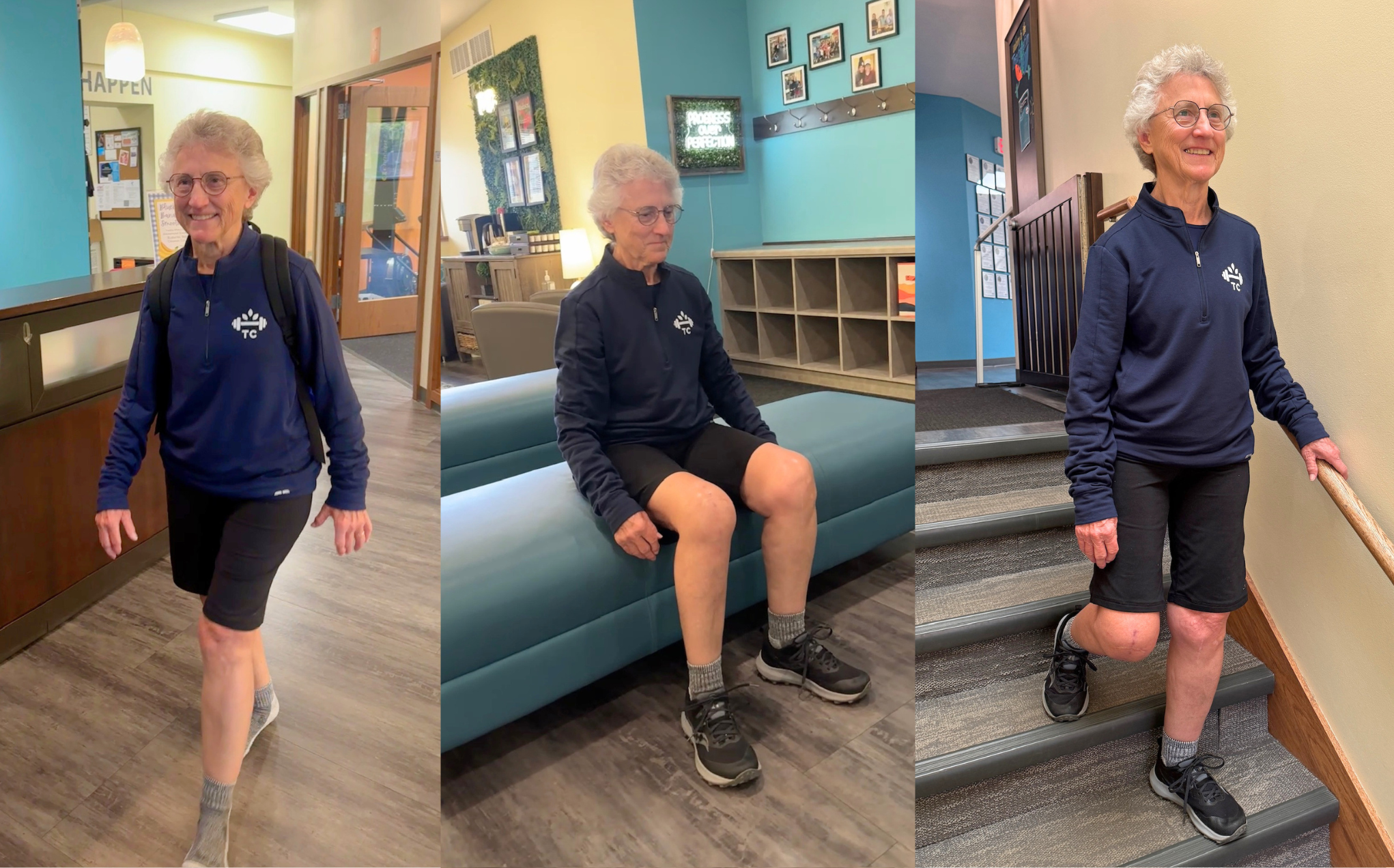
- Walking in the community with confidence
Early on, it is completely appropriate to use a walker or cane. These tools are helpful for safety and balance as your body heals.
But the long-term goal is independence.
That means being able to walk through your neighborhood, the grocery store, or the gym without relying on an assistive device. Some people may still choose to use a cane for light balance support, and that is perfectly fine. The key is that you are not dependent on it.
Getting there requires more than just walking. It requires rebuilding strength, coordination, and confidence in the surgical leg, so your body trusts it again.
- Navigating stairs with control
Stairs are one of the most common challenges after a hip or knee replacement.
Early on, you may use a step-to pattern, going one step at a time. That is part of the process.
But the goal is to return to a reciprocal pattern, where you step up and down normally, using a handrail for light balance if needed.
This requires strength, especially in the hips and thighs, as well as balance and control. It is also where a lot of people realize they are not quite as strong as they thought, which is why progressive strengthening becomes so important.
- Getting up from a chair with ease
Sit-to-stand might seem simple, but it is one of the most important functional movements we do every day.
The goal is to be able to stand up from a chair independently, ideally without using your hands for support.
Why does this matter? Because it reflects true lower body strength and independence. It is also something that directly impacts your ability to stay active, get up off the couch, use the bathroom independently, and move through your day with ease.
Where many people get stuck
Most people do quite well in the early phases of recovery.
You go to physical therapy. You do your exercises. You make progress.
But then something happens.
Formal rehab ends… and the progress slows down or even plateaus.
This is often because the focus shifts away from building capacity.
You may feel better, but you are not yet as strong, as mobile, or as resilient as you need to be for the life you want to live.
This is where the next phase of recovery matters most.
Thinking beyond rehab: building capacity for life
At the Transformation Center, you are surrounded by an environment that supports long-term health and movement.
This is where we shift from rehab to wellness.
From getting by to actually feeling strong again.
This next phase might include:
- Continuing to build lower body strength through progressive exercises
- Improving balance and stability to reduce fall risk
- Working on mobility so your new joint moves well and comfortably
- Returning to activities you enjoy like walking, strength classes, or other forms of exercise
For some, this may also include wellness-based support such as soft tissue work to help the body move more comfortably as it adapts to increased activity.
This is not about pushing through pain.
It is about continuing to load your body appropriately, so it adapts and becomes more capable over time.
Don’t forget the bigger picture
Recovery is not just about your hip or knee.
Your whole system matters.
Sleep, nutrition, and overall activity levels all play a role in how well you heal and how strong you become afterward.
Simple things like getting enough protein to support muscle recovery, staying consistent with movement, and allowing your body time to rest can make a meaningful difference.
Final thoughts
Hip and knee replacements can be life changing in the best way.
But the surgery itself is only one piece of the puzzle.
Your long-term outcome is shaped by what you do after.
Focus on the things that matter:
- Walking confidently in your community
- Navigating stairs with control
- Getting up and down with ease
And most importantly, continue to invest in your strength and movement even after formal rehab is done.
Recovery doesn’t end when therapy ends.
It continues as you learn how to support your body, challenge it appropriately, and rebuild trust in how it moves.
That’s the work of learning how to love your body well and load it wisely.
What’s next?
If you’ve completed your formal rehabilitation and are wondering how to continue building strength and confidence safely, you are not alone.
I’m currently exploring ways to support this next phase through wellness-based offerings here at the Transformation Center, focused on strength, balance, and long-term joint health.
If that’s something you’d be interested in, I’d love to hear from you. Feel free to reach out or connect with me at the Transformation Center.
Recent Comments