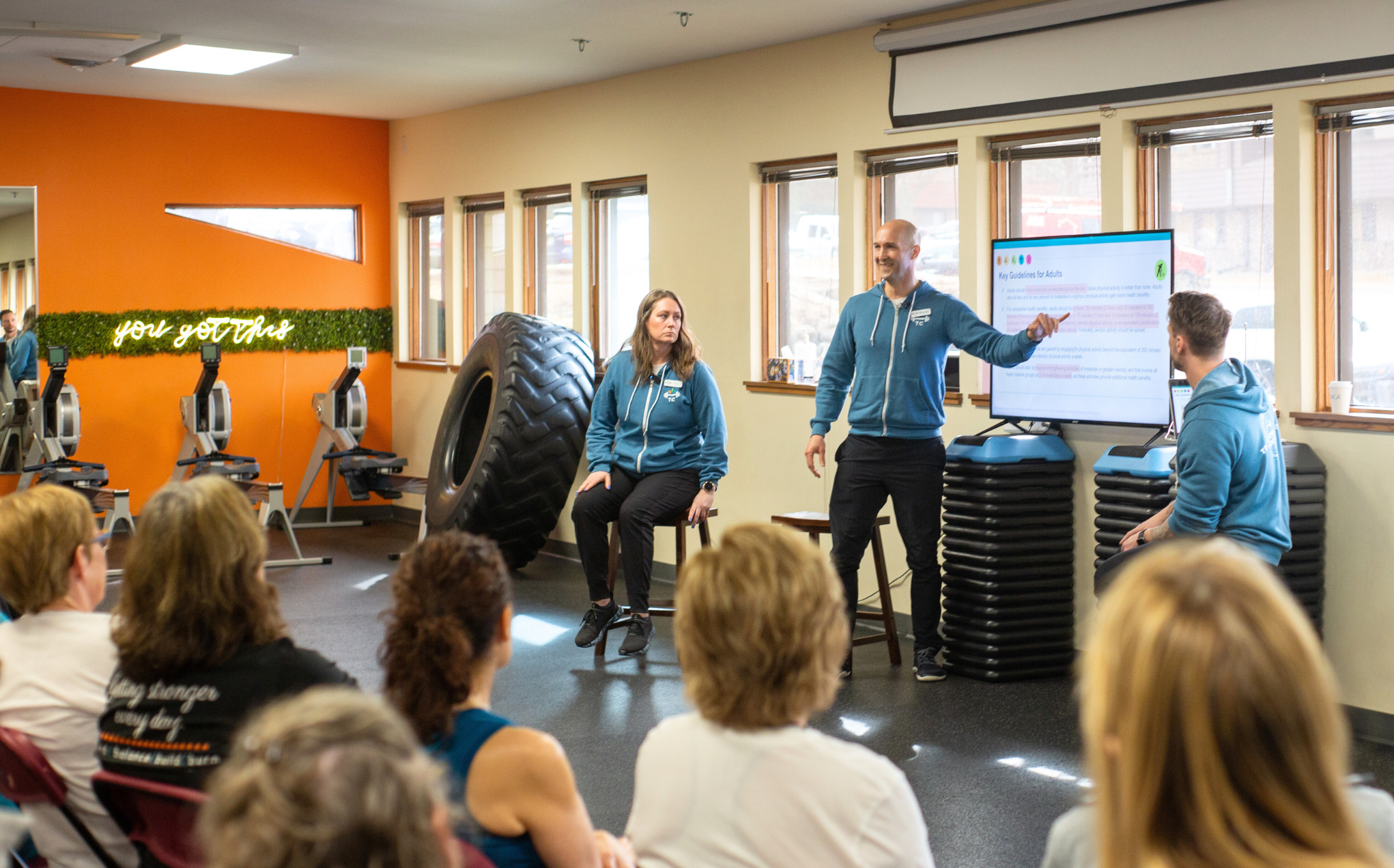
Prior to becoming a trainer, and eventual co-owner, at the Transformation Center, I spent a good chunk of my early career as a scientist committed to educating the general public on a variety of topics, but also exploring ideas and concepts that I found interesting. As a trainer, I’ve continued that pattern and continued to learn, educate and provide practical tools to clients and the broader Madison area through talks on joint health, mobility methods to keep us moving, the effects of aging on our bodies, and the necessity of staying strong and fit as we all get older.
An area of research that I want to dive into a bit with this blog is the mind-body connection, with more emphasis on the mind portion. In every 1-on-1 or group training session that I conduct for joint health and mobility, I emphasize how important improving that connection in both directions (brain to body, as well as body to brain) is to controlling how your body moves and how your body interprets what your mind is asking. This topic has become especially relevant to me on a much deeper, and very personal, level over the last 5 years with my dad’s Alzheimer’s diagnosis. While my dad has never been one for the spotlight or would consider himself a huge extravert, the manner in which conversation and communication have changed really pushed me to learn more about how the things we do at the TC might be helpful in his new journey and explore other, science-based methods that might be able to be more helpful, not just for my day, but for anyone looking to keep a sharp mind.
The Best News First…Because Why Wait?!
First things first…the brain is capable of changing (neuroplasticity), regardless of age, and exercise is the best way to keep a strong mind. In fact, exercise is the single most powerful tool we have for keeping our minds sharp, our memories intact, and our spirits lifted. Much like the body was once thought to follow a steady, predictable path of decline, the brain was as well, and this just isn’t the case at all! Rather than think of the brain as a fixed machine accumulating rust, a better analogy is to consider the brain as you would any other muscle in your body – to strengthen the muscle, the key is to challenge your current abilities (e.g., through strength/resistance training), which provides the necessary signals for your body to respond (e.g., lay down more lean muscle). Staying cognitively fit follows a very similar principle as strength training where the brain must be challenged, much like lifting a heavier dumbbell. The good news is that the act of moving while you exercise is the first step in challenging your mind! Whether you take daily walks for fresh air, exercise at a gym like the TC, or participate in organized sporting events, all of them initiate the production of a substance that scientists call “Miracle-Gro for the brain.” While the technical term is BDNF (Brain-Derived Neurotrophic Factor), let’s stick with the Miracle-Gro analogy because it is very aligned: BDNF helps to nourish your brain cells, helps to grow new connections, and even helps in the production of new brain cells.
If you’re wondering about the impacts of exercise-produced BDNF, I’ll keep it simple:
- Exercise helps to protect your memory,
- Exercise helps to sharpen your thinking,
- Exercise helps to lift your mood, and
- Exercise helps to reduce your cognitive decline.
Movement Counts, but Consistency and Challenge Matter More
If movement while you exercise is the starting point for maintaining and improving cognitive fitness, consistency and the types of challenges we provide our brain are the keys to longevity. While the exercise or movement doesn’t seem to matter as much as one might think, what are important are 1) the regularity, 2) the duration, and 3) the intensity with which you perform your exercise or movement. The current recommendation by the American Council of Sports Medicine (ACSM) is at least 150-300 minutes of moderate-intensity exercise or 75-150 minutes of high-intensity exercise. If that seems like a lot or feels intimidating, remember that is the ideal and anyone can start with 5-10 minutes per day. To further help, choose movements or exercises you enjoy as an individual or become part of a community of like-minded people.
To wrap up and lay the groundwork for things to come, let’s talk about the value and importance of the challenge required to keep the mind sharp. Several types of “brain game challenges” are quite common and readily available, including: crossword puzzles, physical puzzles, memory challenges, and multiple apps, each with slightly different designs for differing purposes. While I am a huge proponent of all of those activities, more and more research is suggesting they serve more as a baseline rather than an end product. The reason? For each activity aforementioned, all of them are likely missing the opportunity to improve BOTH the mind and body and are primarily addressing ONLY the mind. I will be the first to say working the mind alone is better than nothing, but that leaves a diminishing, and ever accumulating, gap between in the brain-body connection. So the question becomes, “how do we improve our connection?” One of the answers, and the one I have spent the most time learning about and beginning to implement in both 1-on-1 and group trainings, is called dual tasking. It’s exactly what it sounds like, you are literally doing two things (at minimum) that challenge your thought process, while simultaneously incorporating body movement(s). A simple example of dual tasking, which I’ll dive much more into in a later blog post, would be something like this: you are provided a string of 3 letters that each correspond to 3 movements (e.g., lateral step a short hurdle, pick up and toss a ball to your self, and step onto a soft pad). If you hear, “A, B, C,” you would then perform each exercise in the order performed. Mixing up the letters adds a level of challenge. Asking you to perform the movements quicker adds a level of challenge. Adding in more letters to the sequence adds in even more challenge (e.g., “B, C, A, C”). As you can see, the opportunities are endless!
I’m going to end this blog by encouraging you to be/stay active and to consider adding some type of activity that challenges your mind (if you aren’t already).
Keep moving (and challenging your brain-body connection!),
Brent
Recent Comments