
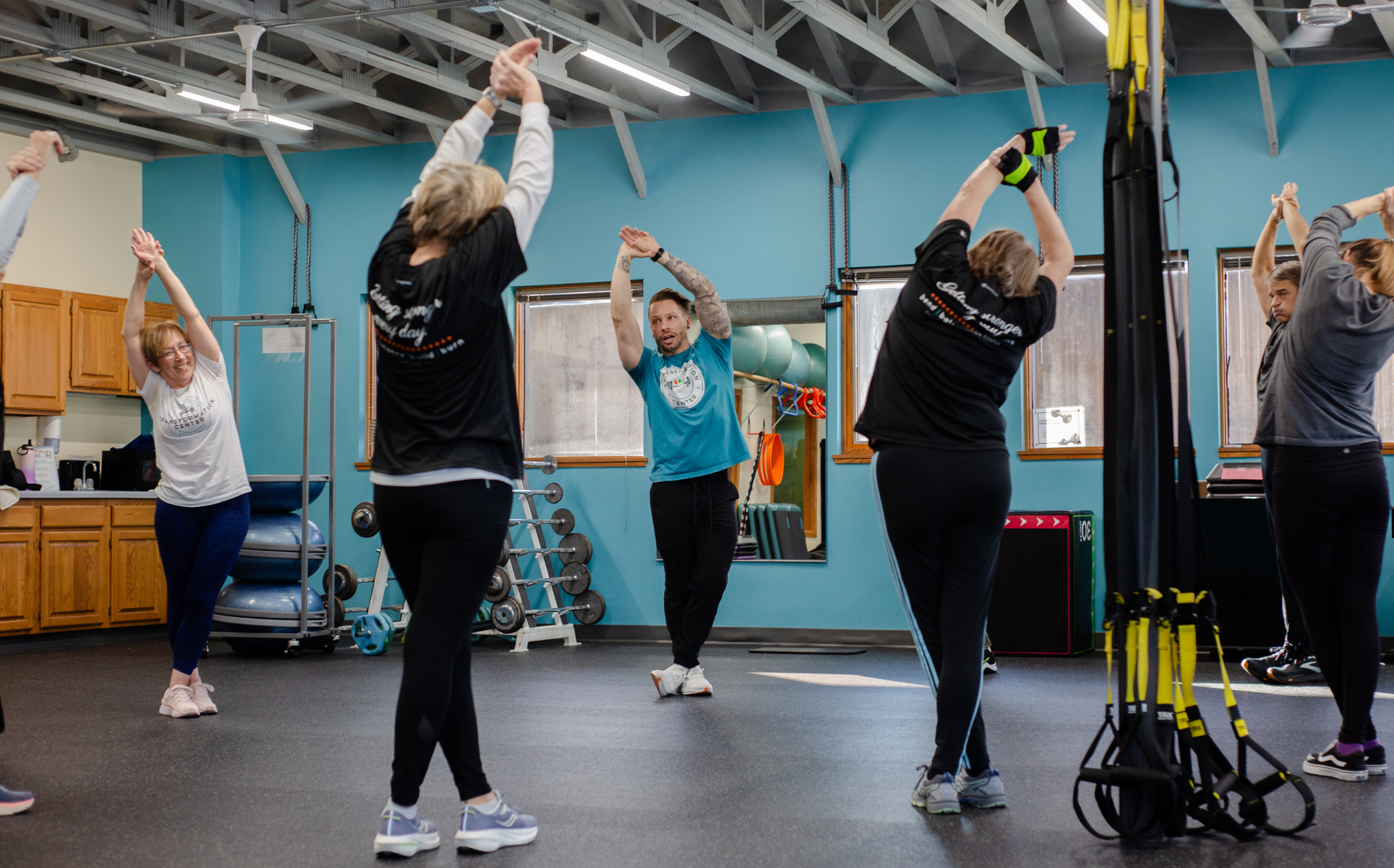
You know the routine. You walk into the gym, throw a leg up on a bench, and hold a hamstring stretch for thirty seconds. Maybe you reach for your toes. Maybe you pull a heel to your glute and hold on to a wall for balance.
Most of us learned this in a gym class somewhere around 1985, and nobody ever came back to tell us otherwise. Or at least it wasn’t loud enough to set something different in our minds long term.
Here’s the thing though. That’s not a warm-up. It’s a stretch. And those are two very different jobs.
So what is a warm-up actually for?
This is the part that gets skipped, and it matters more than any specific exercise we could list.
A warm-up has a few real jobs: raise your tissue temperature, get blood moving, take your joints through the ranges you’re about to use, wake up the muscles that tend to stay quiet, and prep your nervous system so it’s ready to actually recruit muscle when you ask.
That last one gets overlooked constantly. Strength isn’t just muscle, it’s your brain’s ability to call on that muscle quickly and completely. A cold nervous system is a slow nervous system. You’ve felt this. The first set always feels heavier than the third set, even though the weight didn’t change.
Holding a static stretch does almost none of that. You’re not warmer. Your heart rate hasn’t moved. Your nervous system is, if anything, a little more relaxed than when you started.
The injury conversation, honestly
Here’s where we’re going to say something that might surprise you, because we’d rather tell you the truth than repeat the thing everyone repeats.
Stretching does not prevent injury.
We know. Everyone has been told the opposite for decades. But when researchers pooled data from over 26,000 people, strength training reduced sports injuries to less than a third and cut overuse injuries nearly in half, while stretching was the one intervention that showed no meaningful protective effect. A 2025 consensus statement from international stretching researchers landed in the same place and does not recommend stretching for injury prevention.
So if stretching isn’t the thing keeping you safe, what is?
Being strong. Specifically, being strong in the positions where you actually work. That’s the whole argument for what we do here. Your squats, your carries, your rows, your step-ups, the boring consistent stuff, that’s your injury insurance policy. Not the thirty seconds you spend reaching for your toes.
None of which means skip your warm-up. A good warm-up still matters, and dynamic warm-ups do show favorable effects on injury rates in the research. It just does its job by preparing you to move well, not by stretching you into safety. Better prep means better movement quality, better movement quality means better training, and better training is what builds a resilient body.
Is static stretching bad, then?
No, and this is where a lot of the internet gets it wrong in the other direction.
Static stretching before training got a bad reputation because long holds can temporarily reduce force and power output. That effect is real. It’s also smaller and more forgiving than the headlines suggest. When static stretching is kept to under 60 seconds per muscle group and sits inside a complete warm-up with movement before and after it, the performance effect is usually negligible.
So nobody needs to feel guilty. If you love a particular stretch and it makes your hip feel better before you squat, keep it. Just don’t let it be the entire warm-up, and don’t park there for two minutes.
Static stretching has a home. It’s just usually after, when you’re already warm.
What about bouncing?
You’ve probably heard that bouncing in a stretch is dangerous. We looked into this one specifically, and the honest answer is that the evidence doesn’t really support the warning. Ballistic stretching is one of the least-researched methods out there, and reviews looking for evidence against it have come up short.
Our position is simpler than “it’s dangerous.” We don’t program bouncing because it’s uncontrolled, it’s hard to teach in a group, and we have better tools that do the job with more precision. That’s a coaching decision, not a safety alarm.
The Five-ish Phase Warm-up
A framework we lean on comes from Dr. John Rusin’s Pain-Free Performance Specialist system, and one of the most complete approaches to warming up we’ve found. It’s not a random collection of movements. Each phase does a specific job, and they build on each other.
Phase 1: Dynamic Stretching. Movement-based, actively taking joints through range instead of holding a position. This raises temperature, increases blood flow, and gets tissue moving. Think leg swings, arm circles, walking knee hugs, cat-cow, open books, ankle rocks. Roughly 8 to 12 controlled reps per movement, or about 30 seconds each. You’re not trying to reach maximum range, you’re waking things up.
Phase 2: Corrective Exercise. This is where you address your specific stuff. Positional breathing, wall slides, a hip flexor position that opens up what sitting all day closed down. Two or three movements, 30 to 60 seconds each. This is the phase most people skip, and it’s the one that pays the biggest dividends over years.
Phase 3: Muscle Activation. Some muscles go quiet. Glutes especially, and the deep core, and the muscles between your shoulder blades. Activation work turns them back on before you load them. Glute bridges, clamshells, band pull-aparts, bird dogs, scapular push-ups. About 10 to 15 reps, low intensity, focused. The goal is feeling the right muscle work, not fatiguing anything.
Phase 4: Movement Pattern Prep. Now you rehearse the actual patterns you’re about to train. If you’re squatting, do bodyweight squats. If you’re hinging, practice the hinge. If you’re pressing, do a few push-ups or band presses. This is a dress rehearsal for your nervous system. One or two sets of 5 to 10 reps.
Phase 5: CNS Stimulation. The last step is a quick jolt to the nervous system so you’re ready to produce force. This can be light med ball throws, quick pogo hops, fast marching, or brisk step-ups. Short and snappy, 10 to 15 seconds of work. And to be clear, this does not have to mean jumping. Fast, controlled marching or quick tempo bodyweight movements accomplish the same thing for anyone who shouldn’t be leaving the ground.
Phase 6: Soft Tissue Work. This one is a bonus, and it actually goes before everything else. Foam rolling or targeted soft tissue work on tight areas can make the rest of the warm-up more productive. In a group class setting this is honestly tough. Class time, room capacity, and keeping fifteen people moving together make it hard to fit in. But if you show up ten minutes early and hit your two problem spots, you’re giving yourself a real advantage.
The whole sequence takes about 8 to 10 minutes done well. The reason it works is that it’s a ramp, not a switch. You start slow and low intensity, and by the last phase you’re moving with real speed and intent. That progression is the point and something you may notice (condensed) in your sessions.
Another tool we use: CARs
You’ve probably done these in class without knowing what they were called, or not.
CARs stands for Controlled Articular Rotations, and they come from Dr. Andreo Spina’s Functional Range Conditioning system. If you’ve ever been told to slowly circle one shoulder while keeping the rest of your body absolutely still and tense, that’s a CAR.
They look like joint circles. They are not joint circles.
The difference is tension and control. In a lazy arm circle, momentum does the work. In a CAR, you generate full-body tension first, sometimes called irradiation, then move the joint slowly through its outer limit under your own muscular control the entire way. You’re trying to expand the circle a little each rep, and you’re paying attention to where it catches.
Why it matters: your joint capsule is loaded with sensors that report to your brain. Moving a joint slowly and deliberately through its full rotational range floods your nervous system with information about that joint, and your brain responds by giving you more control over it. Range you can’t control isn’t range you own.
The other benefit is that CARs are an assessment. Do them regularly and you start noticing things. That left shoulder catches at the same spot every time. The right hip moves further than it did a month ago. That’s real information about your body that nobody else can gather for you.
Warm-ups: which one, when?
Both. They’re answering different questions.
The five-phase warm-up focuses on today’s session. It’s preparation, it’s sequenced, it ramps toward intensity, and it’s specific to the work you’re about to do. You do it because you’re training in ten minutes.
CARs are about your joints over the long haul. They’re maintenance, they’re slow, they’re not tied to any particular workout, and the payoff builds over months. You do them because you’d like your shoulders to work when you’re 80.
Use the warm-up before you train. Use CARs daily if you can, or at least on the days you’re not here. Five minutes of CARs on a rest day is one of the highest-return five minutes in fitness, and it costs nothing but attention.
Does any of this change as we get older?
It does, and this is where our 60, 70, and 80-year-old members should lean in.
A few things shift with age. Tendons and connective tissue get stiffer and less compliant. It takes longer to raise tissue temperature and get blood flowing. Proprioception, your sense of where your body is in space, gets fuzzier, which affects balance and control. And muscle mass declines steadily from your thirties onward unless you’re actively defending it.
What that means practically is not “do less.” It means give yourself a longer ramp. A 40-year-old might feel ready after five minutes. A 75-year-old might genuinely need more, and that’s not a weakness, it’s just physiology.
Rushing the warm-up is where people get into trouble, because they hit their working sets before their body caught up.
The activation and CNS phases matter more with age, not less. Waking up quiet glutes and reminding your nervous system how to move quickly is exactly the work that protects balance, reaction time, and the ability to catch yourself when you trip. That’s independence, and it’s trainable at any age.
What if you have a specific joint issue?
Most of us are carrying something. A shoulder that doesn’t go fully overhead. A low back that complains. Knees that don’t love stairs. A hip replacement. Decades at a desk.
The general pattern is worth understanding, because these things are usually connected:
Shoulders are often limited by the upper back, not the shoulder itself. If your thoracic spine doesn’t extend and rotate, your shoulder has nowhere to go. Open books, thread-the-needle, and wall slides tend to help more than shoulder stretches do.
Spine issues frequently trace back to hips. When hips don’t rotate or extend well, the low back picks up the slack it wasn’t designed to carry. Hip CARs and 90/90 work often do more for a cranky back than back exercises.
Knees live between the ankle and the hip. Stiff ankles and weak hips both force the knee into positions it doesn’t like. Ankle mobility work and glute strength usually matter more than anything done directly at the knee.
Hips get short and quiet from sitting. Hip flexors shorten, glutes go dormant, and then we ask them to squat. Dynamic hip openers and glute activation address this directly.
Now, the honest part. In a group class with fifteen people, we can’t run a personalized corrective program for every individual limitation. We modify, we cue, we watch, and we adjust what we can in real time. But the deeper work on your specific shoulder or your specific hip is best done outside of class.
Five to ten minutes at home, a few days a week, on the thing that’s actually limiting you. That’s what moves the needle, and it makes everything you do in class better.
And after the workout?
This is where static stretching finally earns its slot. You’re warm, tissue is pliable, and there’s no performance to protect anymore.
Be aware of what it will and won’t do, though. Post-workout stretching as a standalone recovery tool doesn’t appear to meaningfully reduce muscle soreness or speed strength recovery, based on current research. It’s not the soreness cure it’s been sold as.
What it does do is feel good, help you downshift out of training mode, and, done consistently over time, genuinely improve your range of motion. Those are decent reasons. Just don’t expect it to erase tomorrow’s soreness.
Key Points
A warm-up should raise temperature, mobilize joints, activate quiet muscles, and prep your nervous system. Holding stretches does none of that.
Stretching does not prevent injury. Strength training does, by a wide margin.
Static stretching isn’t harmful, it’s just not a warm-up. Save the longer holds for after.
The five-phase sequence works because it ramps: dynamic stretching, corrective work, activation, movement prep, then CNS stimulation. About 8 to 10 minutes.
Soft tissue work is a worthwhile bonus if you arrive early enough for it.
6 phase warm up and CARs.
Bodies over 50 need a longer warm up ramp, not a shorter one. Even ten to twelve minutes is reasonable past 65.
Specific limitations are best addressed in short sessions outside of class.
Where to go from here
If you’re dealing with a limitation, or you want to explore more options for improving your mobility, movement quality, or power, talk to one of your trainers. Grab us before or after class.
We can usually point you toward a few things to work on at home, suggest which of our programs might fit what you’re after, or just watch you move for two minutes and tell you what we see. That conversation is free, and it’s honestly one of the better uses of five minutes you’ll find.
Reminder
This article is educational and isn’t medical advice. If you’re managing an injury, recovering from surgery, or dealing with ongoing joint pain, work with your physician or physical therapist. We’re always happy to coordinate with what your provider has you doing.
References
Behm DG, Alizadeh S, Daneshjoo A, Konrad A. Potential Effects of Dynamic Stretching on Injury Incidence of Athletes: A Narrative Review of Risk Factors. Sports Medicine. 2023.
Lauersen JB, Bertelsen DM, Andersen LB. The effectiveness of exercise interventions to prevent sports injuries: a systematic review and meta-analysis of randomised controlled trials. British Journal of Sports Medicine. 2014.
Lauersen JB, Andersen TE, Andersen LB. Strength training as superior, dose-dependent and safe prevention of acute and overuse sports injuries. British Journal of Sports Medicine. 2018.
Behm DG, Blazevich AJ, Kay AD, McHugh M. Acute effects of muscle stretching on physical performance, range of motion, and injury incidence in healthy active individuals: a systematic review. Applied Physiology, Nutrition, and Metabolism. 2016.
Practical recommendations on stretching exercise: A Delphi consensus statement of international research experts. Journal of Sport and Health Science. 2025.
Effects of post-exercise stretching versus no stretching on lower limb muscle recovery and performance: a systematic review and meta-analysis. 2025.
Rusin J. Pain-Free Performance Specialist Certification (PPSC) warm-up framework.
Spina A. Functional Range Conditioning, Functional Range Systems. Controlled Articular Rotations.
Recent Comments